sábado 18 de abril de 2009

Mujeres enjuiciadas/Women on trial

Recientemente el Fondo de Cultura Económica publicó El Libro Rojo, Continuación, una compilación de escritos e imágenes ilustrando crímenes históricos en la ciudad de México. A mí me tocó inventar la imagen para la historia Dos crímenes, dos víctimas, los casos de Alicia Olvera y Nidia Camargo, narrada por Elisa Speckman Guerra. La primera mató a su esposo., la segunda a su amante, y a pesar de ser obviamente culpables, eventualmente fueron liberadas las dos. Pueden leer la historia completa en el libro….

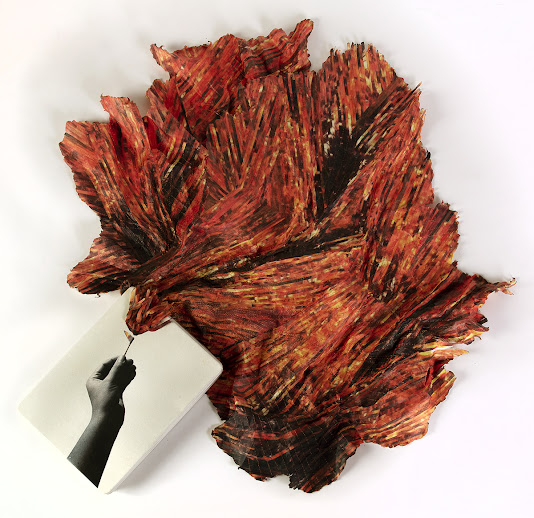
La imagen que hice para el libro. Combina una fotografía de una presa en la corte con un detalle de un grabado japonés (de la colección Carrillo Gil) matando a su amante/The image I made for the book. It combines a photograph of a woma prisioner in court with a detail from a Japanese print of a woman killing her lover


Recently the Fondo de Cultura Económica, a Mexican publishing house, brought out The Red Book, Continuation, a compilation of essays and images illustrating famous crimes in Mexico City. My task was to invent the image for the essay Two Crimes, Two Victims, the cases of Alicia Olvera and Nidia Camargo, narrated by Elisa Speakman Guerra. The first woman killed her husband, and the second, her lover. In spite of being obviously guilty, they were both eventually liberated. The whole story can be read in the book…


Me agradó la historia que me fue asignada porque tiene relevancia con un encargo anterior: hace algunos años fui una de las personas activas en la cultura a quienes se les pidió escoger una fotografía de las archivadas en la Fototeca para luego comentarla, para un número de la revista Alquimia del Sistema Nacional de Fototecas.

Aquí tienen una versión revisada de ese ensayo:

I was happy with the events I was assigned because they were relevant to a previous task: a few years ago I was one of the people active in cultural matters who were asked to choose a photograph from the vast collection of the Mexican national archives, in order to write about the image for the magazine Alquimia published by the institution responsible for the archives.


Following is a revised version of that text:


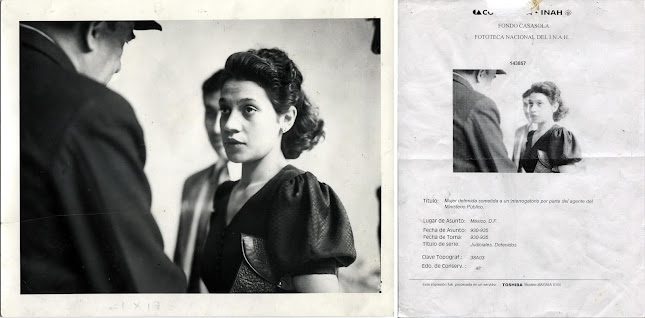
Esta es la fotografía que escogí, del fondo Casasola, "Mujer en juicio", ca. 1920/This is the photograph I chose to comment: Casasola Collection, "Woman on trial", c. 1920


La mujer frente al tribunal

A lo mejor peco de una sensibilidad exagerada al reaccionar a la situación de esta mujer, escogida entre varias en situaciones similares, todas enfrentándose a una sociedad acusadora. Me impacta particularmente la conformación del tribunal, porque todas las fotos que vi están fechadas en una época en que el aparato de la justicia era aún un mundo masculino, sin juezas ni abogadas. Este hecho enfatiza la situación solitaria de la presa, me doy cuenta que lo que me impacta de la escena no es solamente su condición de mujer, pero también su aura de belleza, como si hubiera una contradicción intrínseca entre belleza y culpabilidad.


The Woman before the Court

I probably am guilty of an exaggerated sensibility in my reaction to the woman in this photograph, chosen from among several other photographs of women in similar situations, each and every one confronting an accusing society. I find the conformation of the court particularly noteworthy, as all the photographs I examined of this nature are from a period of time (the first half of the 20th century) in which the apparatus of justice was a male domain, without female judges or attorneys. This emphasizes the solitary situation of the prisoner, and I realize that what strikes me about the scene is not simply the fact that she is female and alone, but also her aura of beauty, as if there were an intrinsic contradiction between loveliness and guilt.


La pintura de Gérome, un poco recortada/Gérome's painting, slightly cropped (1861)


La fotografía mexicana me remite a la interpretación del pintor francés Jean-Léon Gérome de “Friné frente al tribunal”, una obra a su vez presentada en el Salón de 1861 de París, y de tal manera exponiéndose a jueces no menos severos que los encargados de procesos criminales. En cuanto a Friné, ni tenemos que imaginar su aspecto físico-- nos fue conservado por el escultor griego Praxíteles. Resulta que la afamada cortesana (amante del escultor), que disfrutaba de esa curiosa licencia de cultivarse y pensar tolerada en las mujeres así designadas (como las del “mundo flotante” japonés, o las mujeres de la antigua corte de esa nación, albergue de la autora de la primera novela del mundo) fue un día acusada (porque hasta la licencia tiene sus límites cuando uno se mete con los dioses) de impiedad, llevada a juicio, y condenada a muerte. En el momento culminante del juicio su defensor, el orador Hipereides (supuestamente otro amante suyo), imaginamos que con un gran gesto dramático, le quitó su capa, dejando al descubierto su exquisita desnudez…al ver el espectáculo, los jurados no pudieran más que dejarla en libertad.


This Mexican photograph brings to my mind the interpretation of the French painter Jean-Léon Gérome of “Phryné devant l'Areopage”, a work presented in the 1861 Paris Salon, and thus subjected to judges no less severe than those of a criminal court. As for Phryne, we needn’t try to imagine her actual physical aspect- it has been conserved for us by the Greek sculptor Praxiteles. It seems that this renowned courtesan (his lover), who enjoyed that curious license to cultivate herself and her thoughts tolerated in women so designated (like those of the “Floating World” of medieval Japan, or the women of the ancient court of that nation, abode of the -female- author of the world’s first novel) was one day accused (as even such license has its limits when one trifles with the gods) of impiety, taken to court, and condemned to death. In the culminating moment of the trial, her defender, the orator Hypereides (supposedly also her lover), with what we imagine must have been a grand gesture, tore off her cape, revealing her in her exquisite nakedness…witnessing this sight, the judges could do nothing less than set her free.


Una cabeza de Friné como Afrodite por Praxíteles, ca.340 BC/ A head of Phryne as Aphrodite by Praxiteles, c.340 BC


Algunos vieron el cuadro de Gérome como una excusa para el voyerismo barato; otros calificaron el gesto de pudor como digno de una maestra de escuela. Resulta que la actitud de la retratada (a quien vemos cubriéndose la cara, más nada más, con su brazo, y así con los brazos levantados haciendo resaltar el cuerpo expuesto) en esa ambivalencia entre revelar y exponer, encontró tal eco entre los franceses que desató toda una moda de imitarle el gesto en las “cartes de visites” tan populares en la época.


Una tarjeta de visita francesa de la época, con influencia de la pintura de Gérome/A French visiting card from the period,influenced by Gérome's painting


Some saw in the painting of Gérome an excuse for cheap voyeurism; others qualified the courtesan’s gesture of modesty as befitting a schoolmistress. It seems that the attitude portrayed (we see her covering her face, and only her face, with her arm, and her upraised arms serve to underline the exposure of the rest of her body) in quite an ambivalence of revealing or concealing, found such an echo among the French that it unleashed a fad of imitating the gesture in the “carte de visites” popular at the time.


Las mexicanas fotografiadas en las fotos de archivo del Fondo Casasola demuestran un impulso parecido en quererse esconder. Todas las enjuiciadas tienen la cara y/o el pelo cubiertos, con velos, sombreros, el rebozo, o hasta con las manos. Una parte del encubrimiento es típica de la época, pero otra parte importante es atributa de la vergüenza. La desnudez de las retratadas consiste en su vulnerabilidad ante una sociedad que las enjuicia. Por bien o por desgracia, la belleza, que en otras situaciones sociales podría ser escudo o arma, no sirve de escapatoria; no hay clausula legal para ello. Pero hay algo imperativo en sí en el estado de la belleza, desde el cuento de García Márquez en que las mujeres del pueblo declaran que alguien tan triste y tan bello tiene que llamarse Esteban, hasta el obrero muerto de Álvarez Bravo, que nos hace rebelar frente a su desaparición, quizás más por su belleza que por su condición humana. Hay un imperativo que se maneja a nivel frívolo en las mujeres de los anuncios del Palacio de Hierro, que exigen ser perdonadas (o permitidas todo) por ser bellas. Actualmente vemos operar el mismo instinto en el caso de la secuestradora francesa Florence Cassens, defendida por el mandatorio francés como se fuera víctima, no verdugo. Y ¿Cómo es posible, se preguntan sus vecinos, pregunta registrada por los reporteros, que alguien tan bella sea un criminal?


Imagen del fondo Casasola, ca. 1935/Image from the Casasola Collection, c. 1935


The Mexican women I found in the perusal of the photographic archives in the Casasola Collection demonstrate a similar impulse in the desire to hide themselves. All the females accused have their face or hair covered with veils, hats, a shawl, or even with their hands. To a certain extent this tendency to cover themselves up is characteristic of the period, but the rest can be attributed to shame. The nakedness of those depicted consists in their vulnerability before a society which judges them. For better or for worse, it seems that beauty, which in other situations could serve as a weapon or a shield, cannot get them off: there is no legal clause for it. But nevertheless there is something imperative in the simple fact of beauty-- we see it in the story of García Marquez when the women of a fishing village declare that someone so beautiful and so sad must be called Esteban, and in the murdered striker photographed by Álvarez Bravo, whose death dismays us, as much for his beauty as for his simple humanity. There is an imperative bandied about on a frivolous level in the women of certain department store ads who demand to be pardoned for (or permitted) everything because they are beautiful. Recently we have seen the same instinct working in Mexico in the case of the Frenchwoman Florence Cassens imprisoned for kidnapping, defended by the French president as if she were the victim, not the abusing party. And how is it possible, her neighbors ask themselves, a question registered by reporters, that someone so beautiful could be a criminal?


Fotografía de Robert Demachy con infuencia de Gérome, detalle/Photograph by Robert Demachy influencied by Gérome, detail


Muy aparte de lo injusto de reaccionar de forma distinta ante un ser normal y uno con esa dote, y también aparte de la larga y pertinente discusión de la naturaleza de los crímenes y supuestos crímenes perpetuados por mujeres, la mujer frente al tribunal, como una santa frente a la Inquisición, sigue con el extraño poder de convencernos de su inocencia, o verla por lo menos perdonable, no más por el gozo que experimentamos en contemplarla.


Un dibujo mío basada en la fotografía de Demachy/A drawing I did based on Demachy's photograph


Apart from the obvious injustice of reacting differently to a normal person and someone with this blessing, and also apart from the long and pertinent discussion of the nature of the crimes and supposed crimes perpetrated by women, the woman before the court, like a saint before the Inquisition, retains the strange power of moving to us to believe in her innocence, or at least to want to see her as a victim of circumstance and thus worthy of pardon. It is a power rooted in the pleasure we experience as we behold her.


El Paricutín, grafito/papel, 1991-2/The Paricutin, graphite/paper, 1991-2


La serie de dibujos (encontrarán 2 en la entrada anterior) Mujeres Detenidas es una reacción mía más detenida al fenómenon comentado aquí. Fue al examinar las fotografías para escribir este ensayo que me nació la idea de hacer los dibujos, y todos están basados en el fondo Casasola. Lo único malo es que eso de "una reaccion detenida" va en serio-- he tardado años ya y me faltan unos 12 imágenes por dibujar. Aquí está el tercero:


Mujer detenida, México, años 30, 2001/Woman detained, Mexico City, 1930's, 2001

The series of drawings (2 are reproduced in my last entry) "Women under Arrest" is a more detained reaction on my part to the phenomenon discussed above. It was on examining the photographs I saw in order to write this essay that it occured to me to make the drawings, and they are all based on images from the Casasola colelction. But unfortunately I exaggerate this business of detaining myself--I've been working on the series for years and still have 12 to go...Above you see the third.

lunes 19 de enero de 2009

Lo que promete el año/What the year promises

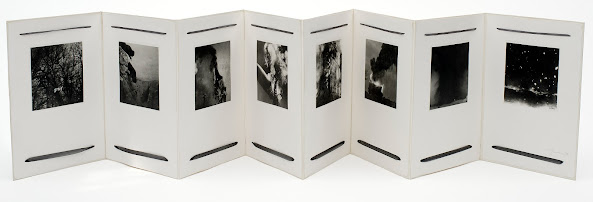
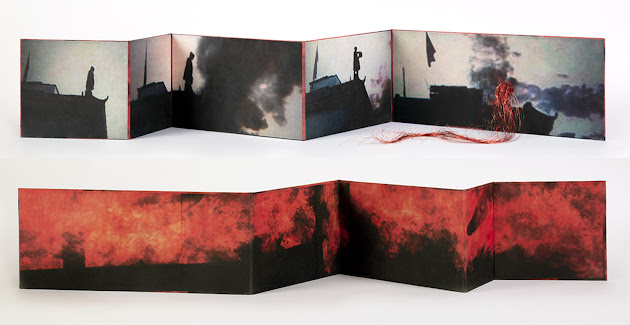
el palacio/the palace-artist´s book/libro de artista, 2008
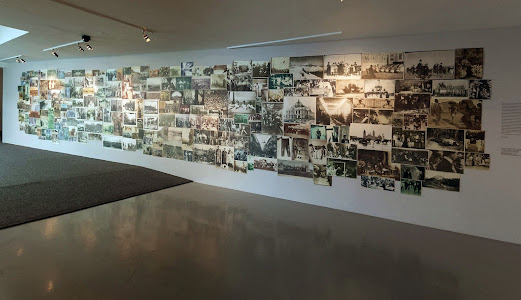
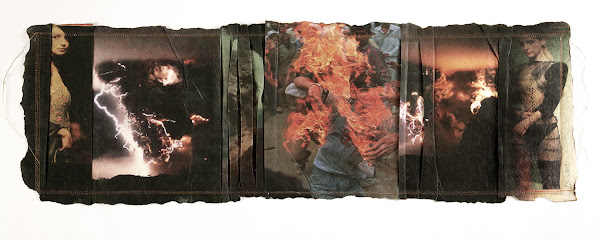
Where have I been? The last blog entries have consisted of material from a show I put together this last year, which tried to portray something of my personal history of migration, related to the experiences of my great-grandparents in the 19th century prairie, and connect this up with the events dealing with Mexicans in the US, on the Border, and in central Mexico, in around the same period. This was a strange experience, as it was not quite a documentary show, because I intervened the photographs I chose, and also not quite a truely personal show, as I restrained myself a lot, working on the photos, so that the show would be more about the history they tell than about myself. Also, I got to respect the photographers quite a lot and wanted them to tell the story themselves.


¿Dónde he estado? Mis entradas de blog de los últimos meses tuvieron que ver con una exposición que armé el año pasado, con la intención de mostrar algo de mi historia personal de migración, relacionada con las experiencias de mis tatarabuelos en la pradera americana decimonónica, y conectar eso con los eventos que concernieron los mexicanos del mismo periodo, en EU, en la frontera, y en México central.


Hacerla fue una experiencia extraña, como el resultado no fue precisamente una obra documental, porque intervine las fotografías que escogí, ni tampoco una expresión personal, porque me controlé mucho al hacer la intervención, tratando de respetar la naturaleza de las fotos y la información que contenían. También en el proceso llegué a respetar mucho los fotógrafos responsables de las imágenes, y quise permitir que contaran su historia, sin intervenir demasiado.


Possibly the work falls into the category of personal revision of public archives, a relatively new field in contemporary art. This show will be moving around the next year or so, as a contribution to events orgainized around the Centennial of the Mexican Revolution, the Revolution being one of the recurrent themes in the show's photographs.
Posiblemente la pieza cae dentro de la categoría de revisión personal de archivos públicos, un campo relativamente nuevo en el arte contemporáneo.
Esta exposición estará viajando durante uno o dos años, como una contribución a los eventos organizados alrededor del Centenario de la Revolución Mexicana, esta revolución siempre una de las temáticas recurrentes en ella.

ANYWAY---EN FIN


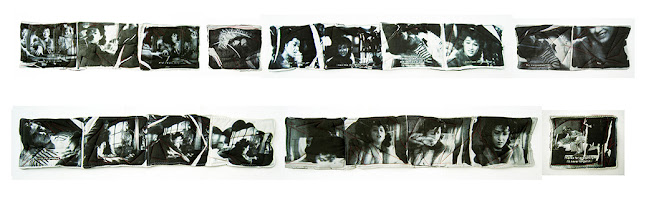
I had a fair amount of material left over from the migration project; some of it wound up as a couple of artist's books.

Me quedó un buen de material del proyecto de migración; parte de ello fue incorporado en unos libros de artista.


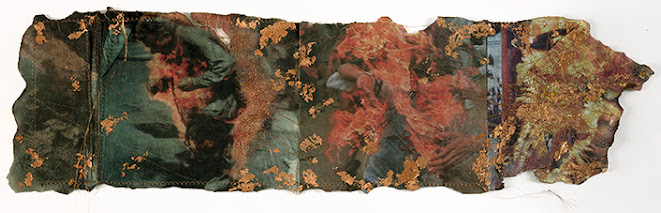
Lazos/ties that bind-artist's book/libro de artista,2009


I am back to the personal.


Ya regresé a lo personal…


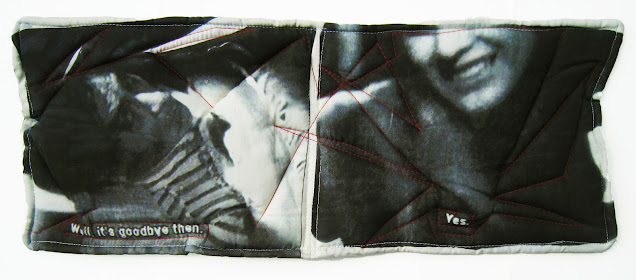
You can see the difference. I'm not worrying about the legibility of the original image, although its (historical?) weight and significance are pertinent to the reading of the resulting work.

Se nota la diferencia. Ya no me estoy preocupando tanto por la legibilidad de la imagen original, aunque su peso (¿histórico?) y significado son pertinentes para la lectura de la obra resultante.


I just start taking the piece where it wants to go, using the same tecnical procedures as in the migration show: transfer and sewing-- but I stopped focussing only on the original image.


Nomás, empiezo a dejar que la pieza vaya por donde se quiere ir, utilizando los mismos recursos técnicos empleados en la muestra original: transferencia y costura—pero dejé de enfocarme solamente en la imagen original.


I really learned a lot from the process of putting together the show--but this,

this makes the whole business a lot more fun.

It goes beyond the document and into my own territory.


Aprendí bastante del proceso de armar esta exposición- pero, trabajar así, libremente, es francamente, más divertido. Va más allá del documento, hacia mi propio territorio.


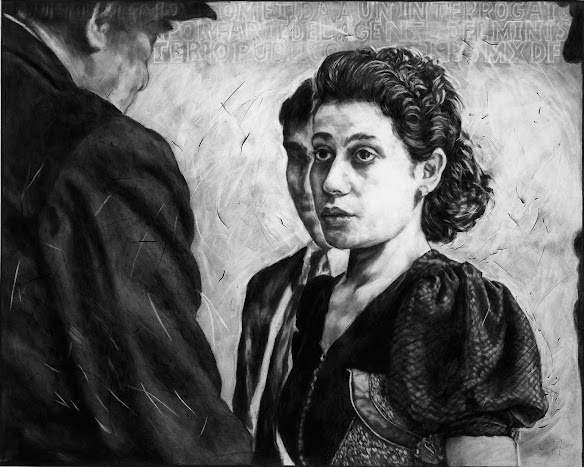
Other projects for 2009: FINISH finally I hope, the series of drawings I started in 2001, based on photographs of the Casasola brothers, of women detained (for what sort of crimes? anyway, maybe the worst moment of their lives) in Mexican police stations, in the 1930's.


Mujer detenida, c.1935/Woman arrested, c. 1935-2008


Otros proyectos para 2009: TERMINAR espero, el conjunto de dibujos que empecé en 2001, basada en fotografías de los hermanos Casasola de mujeres detenidas (¿por qué tipo de crímen? en fin, probablemente el peor momento de sus vidas...) en las delegaciones de DF.


Woman surrounded by interrogating officers/Mujer rodeada por oficiales, c. 1935, 2008


Then I have a show planned for julio, called ELSEWHERE, that elsewhere being a displacement in time or place, but a device totally typical of my work.

You'll be hearing more about this...

Heroic Sushi/Sushi heróico, dyptich/díptico-grabado en relieve con transferencia/relief print with transfer, 2008


Y luego tengo una expo planeada para julio llamada ELSEWHERE (En otra parte), ese "elsewhere" siendo un desfasaje en tiempo o en el espacio, un recurso totalmente típico de mi obra. De esto escucharán más....

miércoles 12 de noviembre de 2008

"When my blood was not yet my blood..."

A journey from Kansas City to Mexico City, 1880-1920

About two years ago I decided to do a project- a polyptych of images—related to migration issues. “We all come from somewhere else” I reasoned, “It’s an indisputable fact. Migration isn’t an invention of Mexicans on the US border—after all, the earth has been populated by thousands of years of human migration.” And that’s what I wanted to emphasize—the universal, or rather, global, character of human migration.

original photograph, Butcher Collection, Nebraska State Historical Society

Another undeniable fact is that the assimilation of new waves of immigrants in any territory is a difficult process, rife with conflict. We are daily witnesses of the treatment received by Latin Americans when they arrive in the United States, my own native country. But those who receive them badly also descend from immigrants: territoriality trumps memory.

So I wanted to try to recover something of that memory. I decided to develop a project involving my own personal or family history of migration, as well as that of my adopted country, Mexico. I wanted to create a bridge between Kansas City, where I was born, and Mexico City, where I have made my life.
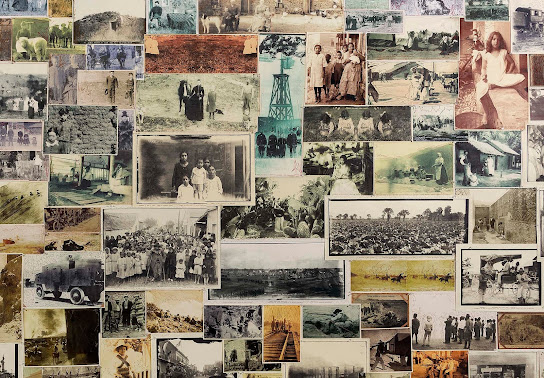
From then on, the project was defined by the results of my research of possible sources of images. I found three important collections of photographs relevant to my idea: the Solomon D. Butcher Photograph Collection (Nebraska State Historical Society), the Robert Runyon Collection (Center for American History, University of Texas at Austin), as well as several of the collections of the Photography Center (“Fototeca”) of the National Institute of History and Archeology of Mexico. These were supplemented by photographs from my own and other lesser collections.


Meanwhile I had defined a historical period to work with: from 1880, when Nebraska Territory was opened to settlement (and my great-grandparents began to establish themselves in the area), until 1920, when the Mexican migration began to consolidate itself. During this period as well the Mexican Revolution took place.


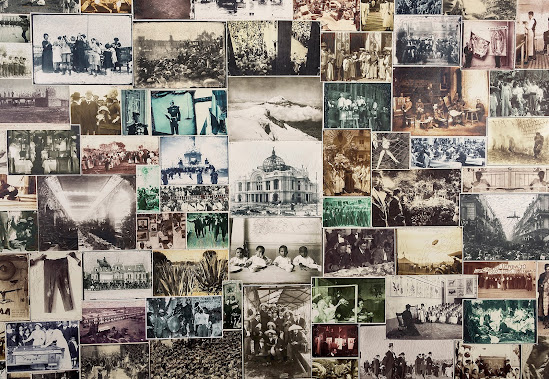
I also defined the way I would work with the material: first I made a selection of photographs with the idea of establishing a narrative. I often cropped the images when it seemed pertinent in order to emphasize certain elements, except when this alteration was not permitted in the conditions established by certain collections.


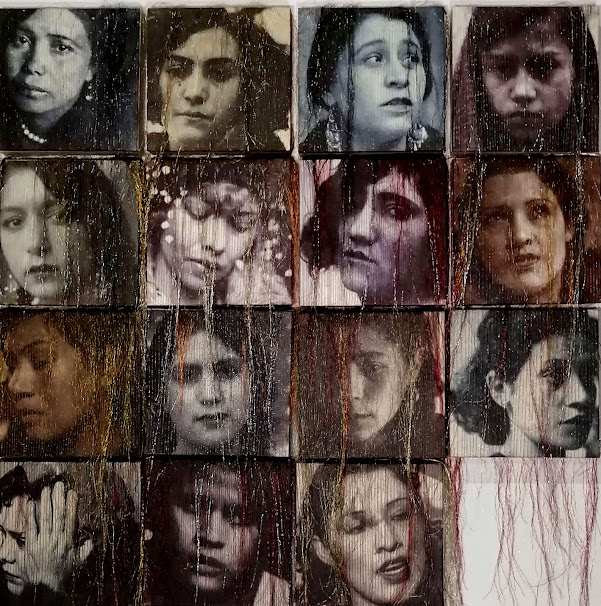
The work was then transferred onto Japanese paper and mounted on a rag backing. The backing permitted me to sew on the images, threading them together almost literally. This unifying device is probably an inheritance from the quilting practiced by my grandmothers.

The recourse of putting together many images, varying the color, can also be seen as a reference to patchwork quilts. Throughout this process I dealt continually with the tension between a desire to respect the integrity and documental value of the photographs and the need to create a coherent whole that might go beyond that, or express something more personal.


The images start off with details of the difficult life led by the early settlers who arrived from farther East or Europe. And the background for the settlers’ even being there was, of course, the drastic and tragic reduction of the original population of the prairie, decimated en previous decades by the armed struggle in defense of their territories, by their exposure to Western diseases, and by their forcible removal to reservations.
From these images the exhibit proceeds to document the Mexicans already in movement in the region, from Kansas and Nebraska down to the region near the frontier, particularly in Texas, where the Mexican presence included the population already in the area since the time when it was part of Mexican national territory, as well as those recently arrived, seeking refuge from the ravaging effects of the Revolution in northern Mexico.


The work documents, though very partially, the destruction caused by that war, refugees, transients looking for work, American troops on the Border, agricultural fields, established families posing in photo studios in Texas, and the improvised camps where the migrants lived in Kansas.

Further south, the show deals with the situation around the turn of the century in Mexico City and the surrounding area: the great metropolis and its contradictions, the war, protests and demonstrations, as well as the life and living conditions of those who stayed behind-- the same conditions which impelled others to undertake the long journey toward the north.

It’s a history of blood in many senses,
from the blood of the Native Americans, the blood and sweat of the refugees and the new settlers on the prairie, and of course, the blood which was shed in armed struggles throughout the region. Our own blood comes from that which flowed in the veins of the protagonists of these events.

In the process of putting together this exhibition I looked at hundreds of photographs. What had been a vague idea in my head became a procession of specific images. And each image exists thanks to the sustained effort of a few photographers, insistently registering the world around them: Solomon Butcher, Robert Runyon, and the Casasola brothers in Mexico, among many others. Finally, only through the diligent task shouldered by the institutions that compiled, conserved, and digitized those photographs could their legacy reach us. This project is dedicated to all the people portrayed in it, and to those who helped preserve their images.

Carla Rippey Mexico City, May 2008

The title of this exhibit cites a text by the Mexican poet Xavier Villaurrutia

domingo 19 de octubre de 2008

"Cuando mi sangre aún no era mi sangre.../When my blood was not yet my blood..."

-- Un periplo desde la ciudad de Kansas hasta la ciudad de México, 1880-1920 Hace dos años decidí hacer un proyecto—un políptico de imágenes- sobre migración. “Todos venimos de otra parte,” razonaba, “es un hecho innegable. La migración no es un invento de los mexicanos en la frontera norte- es más, la tierra se ha poblado por medio de milenios de migración humana.” Y eso es lo que quise subrayar--- el carácter universal, o más bien global de la migración humana.
Otro hecho innegable es que la asimilación de nuevas olas de inmigrantes en cualquier territorio es un proceso difícil, lleno de conflictos. Somos testigos todos los días del trato indigno que reciben los latinoamericanos cuando emigran hacia mi país de origen, Estados Unidos. Pero los que los maltratan también descienden de inmigrantes: territorialidad mata memoria.
Así, quise recobrar un poco de esa memoria. Decidí hacer algo que tuviera que ver con mi historia personal o familiar de migración, y también con la historia de mi país adoptivo. Quería crear un puente entre la cuidad de Kansas, donde nací, y la ciudad de México, donde he hecho mi vida.

De allí en adelante, el proyecto fue definido por los resultados de mi investigación de posibles fuentes de imágenes. Encontré tres grandes archivos fotográficos que me parecían relevantes: la colección de Solomon D. Butcher de la Nebraska State Historical Society, la de Robert Runyon de la Universidad de Texas en Austin, y las múltiples colecciones de la Fototeca Nacional de México. Estas fueron suplementadas por fotografías de otras colecciones más chicas, incluyendo la mía.
Me quedó definida una época a tratar: desde 1880, cuando el territorio de Nebraska fue abierto a colonización (y mis tatarabuelos empezaron a fincarse ahí) y 1920, cuando la migración mexicana empezó a consolidarse en la región.

En medio de este periodo transcurrió la Revolución Mexicana.

También definí el tratamiento que daría al material: hice una selección de fotografías con la idea de establecer una narrativa. Recorté las imágenes cuando me parecía pertinente para enfatizar ciertos elementos, excepto cuando las condiciones de uso de cierta colección restringían la alteración de sus fotografías. El resultado fue transferido a papel japonés y montado en otro papel más grueso. Sobre este soporte, intenté unificar las imágenes con un hilo de dibujo, literalmente un hilo cosido, quizá una herencia de las colchas o “quilts” de mis abuelas. La forma de juntar muchas imágenes, variando el color, también hace referencia los parches o “patchwork” de las colchas.


Estuve siempre en el filo entre el intento de respetar la naturaleza documental de las fotografías y la necesidad de crear una coherencia expresiva para mí misma.
Las imágenes empiezan con detalles de la vida difícil de los pioneros llegados del Este de Estados Unidos y de Europa. El trasfondo de esta situación sería, por supuesto, la drástica y trágica reducción de la población original de la pradera, diezmada en décadas previas por el fallido conflicto armado en defensa de sus territorios, su contagio por enfermedades europeas y su traslado forzoso a reservaciones.

Sigo con imágenes que documentan a los mexicanos ya en movimiento por la región, desde Kansas y Nebraska hasta la región de la frontera, particularmente en Texas. Ahí estaba la población mexicana, presente desde la época en que Texas formaba parte del territorio nacional, además de los recién llegados, arrojados por los estragos de la Revolución Mexicana, refugiados y transeúntes en busca de empleo. Se documenta, aunque muy parcialmente, la destrucción causada por el conflicto, barricadas en Monterrey, las tropas americanas en la frontera, los campos agrícolas, las familias posadas en foto estudios en Texas, y los campamentos de tiendas de campaña donde los migrantes intentaban vivir en Kansas.
Más al sur, documento algo de la realidad a principios de siglo en la ciudad de México y sus alrededores: la gran metrópolis y sus contradicciones, el conflicto armado, las manifestaciones, y en general, las condiciones de vida de los que se quedaron, mismas condiciones que indujeron a algunos a emprender ellargo viaje hacia el norte.
Es una historia de sangre en muchos sentidos, desde la sangre de los indígenas desplazados, la sangre y sudor de los refugiados y de los nuevos pobladores de la pradera, más la sangre de los conflictos armados.
Nuestra sangre viene de la sangre que corría en las venas de los protagonistas de esta historia.


En el proceso de armarla vi cientos de fotografías. Lo que había sido una idea vaga en mi cabeza se volvió una procesión de imágenes precisas.

Cada imagen existe gracias al esfuerzo de un fotógrafo, constante en el campo de acción, registrando insistente el mundo que lo rodeaba:


Solomon Butcher, Robert Runyon, los hermanos Casasola y Huge Brehme, entre muchos otros. Y su gran legado ha podido llegar hasta nosotros por la tarea enorme asumida por las instituciones de recopilación, conservación y digitalización de sus fotografías.
Dedico este proyecto a las personas retratadas y a todos los que ayudaron a que sus visajes hayan llegado hasta nosotros.


Carla Rippey Ciudad de México, mayo de 2008

El título de este texto cita a Xavier Villaurrutia

viernes 29 de agosto de 2008

Volcanes y pirámides/Pyramids and volcanoes

Prudencia/Prudence, 1991, díptico-diptych, 52 x 170 c/uHay formatos que me gustan, muy largos por ejemplo, que se traducen mal al blog. Por ende el dibujo que ven aquí, que debe de verse como una sola tira larga, se ve más bien como cuatro entidades. En fin, se llama Prudencia, por la estatua neoclásica junto a la cual fui retratada (y después me dibujé) en Xalapa, Veracruz, principios de los 90. De allí pasamos a típis en llamas (de una película, creo), barcos en el Nilo, Sadat frente a una pirámide, y luego un volcán mexicano que tiene grabado abajo "Prudencia". Siendo esto una ironía por supuesto, como la prudencia no es una característica mía, ni la es de los volcanes.

There are formats that I like, very long ones, for instance, that translate badly to a blog. So the drawing above, which should be seen as one long stretch, has been divided into 4 separate entities. Anyway, it's called Prudence, for the neoclassical statue next to which I was photographed (basis for my self-portrait) in Xalapa, Veracruz, in the beginning of the 1980's. From there the drawing moves through scenes of teepees in flames (from a movie, I believe), boats on the Nile, Sadat before a pyramid, and finally a Mexican volcano which has engraved below it the legend Prudence. The title is ironic, of course, as prudence has never characterized either me or volcanoes.

Prudence/Prudencia, detail-detalle

En este dibujo se juntan (algo facilitado por su extensión inusual) una pirámide con un volcán, dos elementos recurrentes en cierta etapa (la de Xalapa) de mi producción. Creo que fue el momento en que más me saturaba del paisaje mexicano (donde es común que se asoman tanto volcanes como pirámides, tan parecidos en forma que se confunden en mi subconsciencia). También me gustaba incluir estatuas icónicas en mi obra, como ven abajo:

In this drawing a pyramid is juxtaposed with a volcano (an act facilitated by the length of the piece)-- these are two recurrent elements in a certain stage (that of Xalapa) of my production. I think that was the point at which I was most exposed to Mexican landscape (where both pyramides and volcanoes can loom on the horizon, so similiar in form that I unconciously confuse them). I was also fond of including iconic statues in my work, as seen below:

The Sphinx/La esfinge, 110 x 110 cm 1991

En los dos dibujos hay una especie de recorrido (¿histórico-cultural?) atestiguado por un personaje femenino, a la vez parte de y observadora de la escena...la mujer vidente en esta escena es Jane Morris, modelo (y amante) de Dante Gabriel Rossetti.

In both drawings a (historical-cultural?) distance is covered, witnessed by a female character, who is at the same time part of the scene and an observer of it...the seer in this scene is Jane Morris, model for, and lover of, Dante Gabriel Rossetti.

The Sphinx/El esfinge, detail-detalle


Y además de estatuas, recurría a mujeres posadas tipo tableau vivant, como en este tríptico, en conjunto con escenas del volcán Paricutín. De hecho el Paricutín fue de mis primeras referencias a México, como leí en la primaria del niño que vio cómo salía el humo de una fisura en su milpa.

As well as statues, I made use of women posed as tableaux vivants, as in this triptych, together with scenes from the volcano Paricutín. Actually the Paricutín was one of my first grade-school references to Mexico; I remember reading about the little boy with a donkey who found a thread of vapor coming out of a fissure in his cornfield.

El Paricutín, detalle/detail, 1991
No creo que todo este dramático recorrido histórico haya estado de moda en los 80 cuando me puse a dibujarlo, aunque recuerdo esos años como una época más grandilocuente que la actual. Podrían ser más bien referencias decimonónicas. Pero finalmente, estas atmósferas fueron un asunto mío- al parecer me sentía abrumada por la historia o por mi historia personal...en fin, muy balcón, el asunto.

I don´t remember all these dramatic historical references being particularly fashionable in the 80s, when I drew them- although I remember it being a more grandilocuent period than the present one. They seem to refer more to the nineteenth century. Anyway these particular atmospheres were basically something peculiar to myself- I guess I felt overwhelmed by history, or by my personal history... for better or for worse, the personal became public in my work.

Encontré a las mujeres retratadas aquí en 1) una colección de tarjetas de visita de la Francia decimonónica; 2) un libro viejo de anatomía para artistas; una colección de imágenes eróticas victorianas (eran aficionados de las niñas, se nota).

I found the women portrayed here in 1) a collection of nineteenth century French calling cards; 2) an old anatomy book for artists; and 3) a collection of Victorian erotica (they liked little girls, it seems...).

El Paricutín, tríptico,/triptych, 1991-1992

Estaba ligando lo de "las mujeres y su intimidad" (mi tema por excelencia) y mi versión del paisaje socio-histórico-cultural en que me encontraba.

I was linking together my old theme of "women in their intimacy" with my version of the social/cultural/historical landscape in which I found myself.


Trip to the Pyramids/Viaje a las pirámides, 1985
La mujer en quien basé esta imagen fue retratada en su boudoir por el fotógrafo húngaro radicado en París (años treinta), Brassai. El fondo viene de una revista de la 2o Guerra Mundial, en el norte de África.

The woman I based this drawing on was photographed in her boudoir by the Parisian-based Hungarian photographer, Brassai. The background comes from a magazine about World War II.

From the series, Slaves of Sleep/de la serie, Esclavos del sueño, 1993


Aquí ven un variante sobre el tema, parte de la serie Esclavos del sueño.

Here you see a variation on the theme, from the series Slaves of Sleep. (Somehow it sounds more melodramatic in English).


En el dibujo abajo no aparece ni pirámide ni volcán, pero el triángulo hecho por el helicóptero con los camellos los sugieren...este es un dibujo muy grande (también dividido para acomodarse al formato blog). Las imágenes salieron de una foto periodística del "Desert Storm" y una fotografía del siglo 19.

In the drawing below neither pyramids nor volcanoes appear, although the triangle formed by the helicopter and the camels could suggest them...this is a very large work (also divided here in order to accomodate to the blog). The images came from a newspaper photograph of the "Desert Storm" campaign and a nineteenth-century photo.

Landscape with Vulture/Paisaje con buitre, 222 x 152 cm, 1993

El siguiente dibujo, en papel kraft con lápiz blanco y grafito, comenta la visita de la emperatriz Carlota a Yucatán. De ahí escribí a Europa "Lo más extraño de todo es que yo me encuentro aquí". He de haber sentido algo parecido, desarraigada de Nebraska, hallándome en Veracruz...

The following drawing, in kraft paper with graphite and white pencil, comments the visit of the Empress Carlota to theYucatán peninsula. From that site she wrote back to Europe, "What is strangest of all is that I should even be here". I must have felt something similiar, transplanted from Nebraska to Veracruz.

The Empress Carlota in Yucatán/La Emperatriz Carlota en Yucatán,135 x 103 cm, 1985

Hasta hice un cuadro de hombres en las pirámides, unos chavos de los años treinta o cuarenta, congelados frente al pirámide del sol de Teotihuacán. Ahora en fines de la primera década del segundo milenio, paso por la curiosa experiencia de observar, ¿con nostalgia? mi propia nostalgia de hace 15 a 25 años...
I even did a piece with men in the pyramids, some kids from the thirties or forties, frozen before the Sun Pyramid at Teotihuacán. Now, in the end of the first decade of the second millenium, I'm going through the strange experience of observing, nostalgically?, my own nostalgia of 15 to 25 years ago.

Sunday at the Pryamids/Domingo en Teotihuácan, 1992


domingo 15 de junio de 2008

Todas las demás cosas de la nada/Everything else from the Void

Estoy sacando estas imágenes de una carpeta en mi escritorio (virtual) que dice: blog abril. Obviamente me distraje con otras cosas, pero por fin voy a completar el recuento de mi exposición de arte objeto de 1998 (hace diez años...).

I have an abandoned folder on my (virtual) desktop entitled: April blog. Obviously I got distracted, because just now I am getting around to opening it and completing the account of the exhibit of object art I did back in 1998 (ten years ago...)

El ocaso del imperio-Abdullah es y siempre ha sido una empresa totalmente británica/The Decline of Empires-Abdullah is and always has been an entirely British firm

detalle/detail, 1998 Mi acceso al pasado exótico fue por mucho tiempo el mercado de la Lagunilla ( he perdido un poco la costumbre, y por ende ya no me lleno tanto de chacharas. Me he de estar modernizando).
Ahí encontré en fines de los 90 una cajetilla de cigarros vendida muchos años antes, suponemos que en Egipto, con la siguiente leyenda: "Abdullah" es y siempre ha sido una marca totalmente británica. Aunque tienen fama de irónicos, los Brits aparentemente no vieron la ironía que percibía yo en esta asertación. Pero me dio el título de otro elemento de la serie sobre El ocaso del imperio.

Abdullah is and always has been an entirely British firm/Abdullah es y siempre ha sido una empresa enteramente británica, detalle, 1998

My access to the exotic past was, for quite a long time, the Mexico City flea market called La Lagunilla. (I now have largely lost the habit of going here and hence my rate of accumulation of knick-knacks has slowed considerably. I must be getting more modern).

But I found there in the late 90s a small cigarette box sold (we assume) many years before in Eygpt with the following sentence on it: "Abdullah" is and always has been an entirely British firm. Although the Brits are famous for their sense of irony, they apparently didn't see any in this statement (but I of course did!) And the phrase gave me the title of another element of the series The Decline of Empires.


La cajetilla fue perforada con un abrelatas y en las ventanillas resultantes coloqué dos imágenes en fotocopia. La primera fue de una fotografía antigua (tomada por un británico por cierto) de una procesión de camellos y la segunda de los huesos de un camello. En fin, algo que ver con la presencia de los isleños en el territorio desiértico.
otro detalle/another detail


I perforated the little box with a can opener and in the resulting openings I placed two photocopied images. The first was from an old photograph (taken by somebody British, by the way) of a procession of camels and the second is of a camel's bones. Anyway, it was a commentary on the presence of these isalnd people in a foreign desert.

Se presenta en un marco viejo (mi concepto del momento), sobre una tabla forrada con papel de envoltura viejo.

The work is presented in an old picture frame (my concept of the moment), on a wooden slab covered with old wrapping paper.


Y así lucía (y todavía luce así). ---And this is how it looked (how it still looks in fact.)


También empezó con un marco viejo "El origin del universo". Esta es mi contribución al imaginario del "Big Bang" y fue construída de fieltro, la funda de un cuaderno antiguo, y tul, todo quemado en medio. (Eso de quemarlo fue probablemente un proceso emocionante aunque ya no lo recuerdo).

"The Origin of the Universe" also started off with an old picture frame. It's my contribution to the visualizations of the "Big Bang" and was made out of felt, the cover of an old notebook, and tulle, all of which were burned in the middle. (The burn process should have been exciting in a pyromanic way but I no longer remember it).


Seguí con un par de obras hechas de esquemas escolares viejas, sacadas de una papelería de Xalapa.
I went on to make a couple of pieces out of old school charts, which I got (very cheaply) in a Xalapa stationary store.

Tratado de mutilaciones/Treatise on Mutilations, detalle-detail, 1998

Estas papelerías (ya en extinción como bodegas de mercancía vieja) estaba llenas de cosas de los años 20, 30, 40 etc. que vendía en barato. De allí salieron muchas esquemas italianas escolares, bellamente impresas, que fueron adaptadas como obras de arte (por mi y por Adolfo Patiño).

These stationary stores (which have since ceased to function as warehouses of old merchandise)were full of leftover stuff from the 20s, 30s, and 40s etc. A lot of old Italian school charts, beautifully printed, were rescued from there and made into artwork (by myself and Adolfo Patiño).

Así es que una esquema sobre -la mejor forma de podar- se volvió "Tratado de mutilaciones", reorganizada a mi manera.

Which is how a chart on - the best way to prune- became
a "Treatise on Mutilations" -reorganized to my liking.

Así se ve completo.
Here it is, complete.


Tratado de mutilaciones/Treatise on Mutilations, 1998

Holocausto y Civilización-- Civilization and Holocaust


Estas columnas empezaron como vigas viejas. La de la izquierda tiene encrustada el lomo de un libro (creo que era de Shakespeare pero a lo mejor es invento: le quité el título para que fuera más genérico).

These columns started off as old beams. The one on the left has the spine of a book encrusted in it (I think it was from Shakespeare but I might be inventing that: I erased the title so as to present something more generic).
La de la derecha se llama "Holocausto"-- el hueco está rodeado por un marco de plomo con una estrella de David (Lagunillazo); el interior del hueco está quemado y tiene pegada hoja de plata.
Las bases fueron hechos por un amigo que tiene una fábrica, son de fierro soldado (y muy pesadas).

The one on the right is called "Holocaust" --the hole is surrounded by a picture frame with a star of David (a Lagunilla find of course); the interior es burned and has silver leaf on it. The bases were made for me in the factory of a friend, they're made of welded steel (and extremely heavy).


La verdad es que una base tiene metida una piedra porque hubo una equivocación en las medidas, y tuve que remediar... algo que es central al acto creativo: es una forma de remediar errores. Cuando no podemos solucionar las cosas como "se debe", hay que inventar. Tipico de los creativos: somos malos para hacer las cosas de forma "normal", y así nos vemos obligados a inventar maneras para proceder.


The truth is that one base has a stone wedged into it because a mistake was made during welding in the measurements, and I had to improvise a solution...something quite central to the creative act: it can be a way of making up for shortcomings. When we can't solve things the "normal" way, we invent. Typical of creative people-- we are not good at doing things in the obvious manner and are thus obliged to invent ways of proceeding.


Libro rodeado por su contenido-A book surrounded by its content.


Tenía curiosidad para ver el aspecto espacial de un libro: el área ocupado por sus páginas extendidas. Aunque finalmente, no más pude ver la mitad, como la otra mitad está por el otro lado. Pero todo el libro está pegado, línea por línea, alrededor de la portada. Extrañamente, fue divertido pegarlo, ¿será de bajo estres, como macramé? El libro también es de la Lagunilla y es un tratado sobre cómo admiminstrar un abad: pesando las ventajas del amor contra las del terror (ganó el amor). Y en francés........

I was curious to see the spacial aspect of a book: the area occupied by its extended pages. Although I actually ended up seeing only half the pages, as the other half is printed on the side face down. But the whole book is glued, line by line, in a spiral around the cover. Strangely it was fun to glue it, could it be a non-stressful activity like macrame? The book is also from the Lagunilla and is a treatise on the best way to govern an abbey: weighing the advantages of love against those of terror (love won). All in French...


Libro rodeado por su contenido/Book surrounded by its content, detalle-detail, 1998

Esta obra se expone actualmente (verano del 2008) en el gabinete de gráfica del museo Carrillo Gil, si se animan a pasar a verla.


This piece is currently (summer 2008) on display in the graphics cabinet at the Carrillo Gil museum, if anyone wants to go see it.


Hemos aquí otra pieza también basada en páginas de texto, pero ahora en japonés. Se llama
"Los ancestros".


Here we have another piece based on pages of text, but this time in Japanese. It's called,
"The Ancestors"


Los ancestros, los que han de estar allí aunque no los veamos. En fin, hay que reservarles su lugar.


Those ancestors who must be out there somewhere although we can't see them. Anyway, it's good to reserve a place for them.


El orden admirable de las partes/The Admirable Order of the Parts


Recurrí a un libro de fotografías del siglo 19 para la pieza abajo. La foto fue tomada por Felice Beato, un italiano que recurrió Japón documentando la isla y la gente. Hay una fotografía de un niño crucificado (dice que es un joven pero se ve muy niño), se supone que lo mataron porque mató al hijo de su amo. Ocupé la imagen junto con unas líneas del catecismo otra vez: "El órden admirable de las partes.

I made use of a book of 19th century photographs by the Italian Felice Beato for the piece below.He travelled through Japan documenting its people, landscapes and customs. Here we see a photograph of a crucified child (the book says "a young man" but he looks awfully young), supposedly he was crucified for killing his master's son. I used the image together with a few lines from the Catechism once agian: "The Admirable Order of the Parts".

El orden admirable de las partes/The Admirable Order of the Parts, 1998


Detalle, detail

Tiene como subtítulo lo que viene en la pagina del catecismo: "el infame suplicio de la cruz".
La página es original del catecismo y la imagen en foto es una transferencia.

The page presented is an original from the Catechism and the image is a transfer print.
It has as a subtitle the caption on the Catechism page: "the infamous torture of the cross".


(¡Estas son obras con poca salida comercial!)


(This sort of work doesn't have much commercial outlet!)


Qué hacer con espejo rayado: -- What to do with scratched glass:

detalle, detail


Aquí ven un detalle de un díptico que empezó con el hallazgo de un lagarto muerto en mi jardín (ya ni lagartos muertos hay, los tres gatos los han llevado a la extinción).


Here you see a detail from a dyptich which sarted off with the discovery of a dead lizard in my garden (now there are no lizards left, dead or alive, the three cats have annihilated them).


Eran dos lagartos, la verdad,practicamente una colección. En fin, la pieza corresponde a la idea decimonómica del gabinete de historia natural.


Actually there were two lizards, almost a collection. Anyway, the piece corresponds to the nineteeth century idea of a Natural History Cabinet.

También incluye la imagen de un dragón Komodor acariciado por un niño (de un viejo libro sobre animales).


It also includes an image of a Komodor dragon being petted by a child (from an old English book about animals).


Mímesis/Mimicry, 1998
Se llama, "Mimesis". /It's called "Mimicry".

Aquí la ven completa. /Here you can see the whole work.

Tengo mis épocas de trabajar con retiples. De adolescente hice un dibujo (tipo dibujo de libro infantil) de una joven como yo tomando té con unas enormes víboras (aparece en otra parte de este blog).

I have periods in which I work a lot with reptile images. As a teenage I did a drawing (children's book type of drawing) of a young woman like myself drinking tea with some enormous snakes. (it appears in another part of this blog).
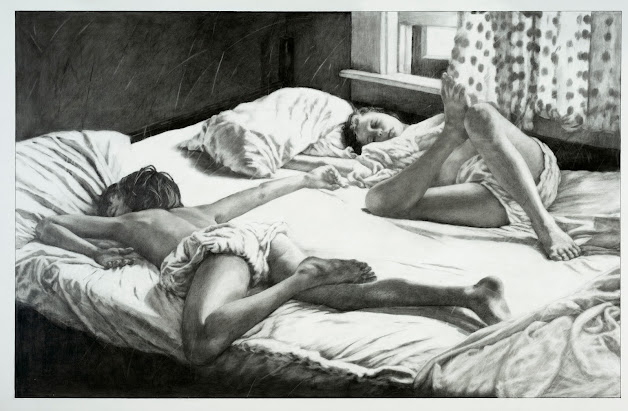
tu típico dragón komodo/your typical Komodo dragon

Y apareció esta misma imagen del niño con el dragón en díptico en dibujo llamado "Lagartona" de 1987.
And the same image of the child with the dragon in a dyptich appears in the drawing called "Lizard Lady" in 1987.

"Lagartona ", (un dibujo muy grande) tenía que ver con los cuestionamientos que tenemos las muejres acerca de nuestros propios cuerpos, como nos vemos, como nos ven los demás. El título salió del comentario de una amiga (tenía ella unos 30 años en ese momento) que de repente se sintió la más vieja del antro --"¡es que me he vuelto una lagartona!
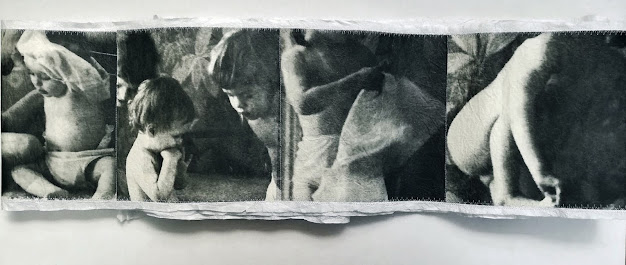
Otra referencia es por supuesto, es al estand típico de la feria mexicana con una mujer lagarta-- "y porqué te volviste lagarta?"-- "¡Por desobedecer a mis padres!"


Lagartona/Lizard Lady, 1987

"Lizard Lady", (a very large drawing) had to do with the self-doubts we woman have about our own bodies and how they affect our relationship with the world. The title came from a commentary by a friend of mine (she was about 30 at the time) who suddenly felt like the oldest female in the clubs-- "I mean I've become the lizard lady!"

Another obvious reference is to the typical Mexican side-show stand with a woman lizard-- "And why were you made into a lizard?" -- "For disobeying my parents!"

La imagen de la parte de abajo del díptico viene de una fotografía del afamado fotógrafo francés de los burdeles de Nueva Orleans, Bellocq.


The image from the bottom part of the dyptich comes from a photo by the famous French photographer Bellocq, who worked in the brothels of New Orleans.


detalle-detail


La pieza "Del finito al infinito" ya apareció en el blog pero hace mucho tiempo, y solamente los muy curiosos que pican "entradas antiguas" lo ven ahora.

Pero se expuso por primera vez en la exposición que estamos recurriendo.


The piece "From the Finite to the Infinite" first appeared in this blog some time ago, but only the very curious who click on "entradas antiguas" see it nowadays.

Nevertheless it was first exhibited in the show under analysis in this entry.


La imagen arriba fue rescatada de una caja de fotografías de la familia de las hermanas de mi papá. Son tías que conocí por primera vez hace unos 15 años, cuando estaban desmantelando la casa de su mama recién fallecida. Representa la entrada de un barco al mar por primera vez.


Todas estas puntas de fuga llevaban años acumulándose en mis archivos cuando finalmente decidí hacer una obra con ellas. Me llamaba la atención de que el punto de fuga puede ocurrir en cualquier lugar y siempre representa lo mismo-- el recorrido de donde estás, hasta el horizonte. Para mi fue una especie de pieza típica de media-vida (mid-life piece, pues, ¡suena mejor en inglés!). Sabía donde estaba, y me preguntaba hasta dónde iba a llegar (todavía no se sabe la respuesta, pero demasiadas personas cercanas a mi-- en edad y en términos afectivos-- ya han desaparecido del horizonte. El más reciente fue Oliver Debroise...)


The image above was rescued from a box of photographs from the family of my fathers' sisters. These are aunts whom I met for the first time around fifteen years ago, when they were clearing out their recently deceased mother's house. It depicts the launching of a ship. All of these vanishing points were accumulating in my files for years until I finally decided to do a piece with them. I found it interesting that a vanishing point can occur anywhere and always indicates the same thing: the path from where you are, to your horizon. For me it was a sort of mid-life piece.

I knew where I was and I wondered where I would end up. (I still don't know the answer, altough too many people close to me, both in age and in affections, have since disappeared from the horizon. The most recent was Olivier Debroise...)


Del finito al infinito/From the finite to the infinite, 1998
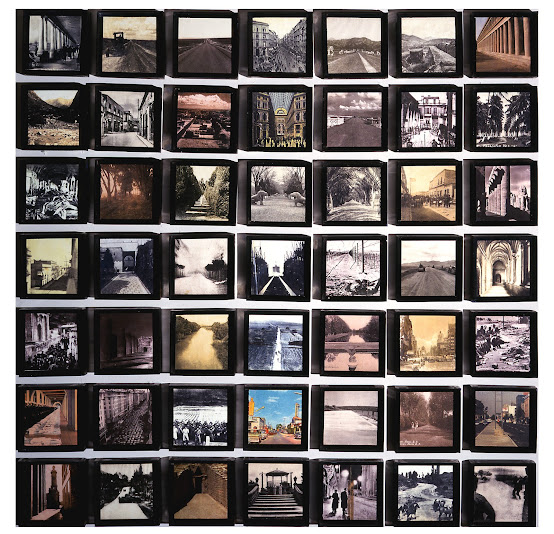
Una obra de transferencias montadas en marcos de hierro, cortesía del mismo amigo de la fábrica. Son 49 pero podrian ser miles.


A work made up of transfers mounted in iron frames, provied by the same friend with a factory. There are 49 but they could be thousands.


Unas últimas obras de la exposición: máscaras con dejo medieval. Una fue hecha de espinas, y otra de un marco de La Lagunilla. La modelo es la mamá de mis nietos, Soledad.


One of the last works in the show, two masks with a medieval air. One was made of rose thorns, and the other from an embossed lead frame found in the "Lagunilla". The model is the mother of my grandchildren, Soledad.


Másacara de la Sagrada Trinidad/Mask of the Holy Trinity, 1998

Y una última máscara: hecha de una hoja de papel pegada a latón, representando la Sagrada Trinidad. Había pensado despegar la hoja del latón pero no pude, entonces decidí hacer un objeto con el latón incluído. En esta exposición traté temáticas religiosas en varias ocasiones. No fue exactamente mi intención de agredir a lo religioso. Fue más bien una actitud de examinar objetos del pasado con su significado original, e interactuar de alguna manera con sus implicaciones en ese contexto, viéndolo como artefacto histórico más que un ícono vigente.


And one last mask: made with a sheet of paper glued to tin, depicting the Holy Trinity. I had planned on separating the paper from the tin but it was impossible, so I decided to do an object including the tin. In this exhibit I worked with religous themes in several instances. It wasn't exactly my intention to challenge religion. My atittude was more that of trying to examine objects from the past considering their original significance, and to interact somehow with the implications in that context, seeing them as historical artefacts more than current icons.


sábado 22 de marzo de 2008

Todas las cosas de la nada/Everything from the Void

Caja para relíquias/Boxes for relics, 1998 The work in this entry comes from a show I did in 1998 (in Mexico City's Museo Universitario del Chopo) of object art- something I had been wanting to do for some time ( it's more entertaining than drawing). Gustavo Prado and Adolfo Patiño (Mexican artists and curators) helped me with this show, working in the assembling of the pieces and the exhibition design, more or less under my direction. The phrase Everything from the void comes from a book of Catholic catechism that I picked up in the famous Mexico City flea market, "La Lagunilla".

detalle del libro con la frase "todas las cosas de la nada"/detail of the book with the phrase Everything from the void", principios del siglo 20-early 20th century
La obra en esta entrada viene de una exposición que hice en el Museo Universitario del Chopo (Ciudad de México) en 1998. Llevaba años queriendo hacer una exposición de arte-objeto (que es mucho más divertido que dibujar) y colaboraron conmigo (más o menos bajo mis instrucciones) en la hechura de la obra y museografía, Gustavo Prado y Adolfo Patiño. La frase Todas las cosas de la nada, el título de la exposición, viene de un catecismo católico que encontré en la Lagunilla.

Vista parcial de la exposición/View of part of the show, 1998

The idea of the show was to make a sort of remix (once again, the collage concept!) of a lot of material I had been gathering together, mainly old things, many with historical or ritual implications. The image above depicts an installation made up of a collection of old slateboards from a Mexican country school, to which I added pieces of slate in rock form to make a series of small landscapes, like mountain lakes. They were presented on tables made of sideboards from a truck. The large work is an old beam with slate inserted, called Horizon. The background contains old German miitary maps.

The show was held in a building which was designed by Eiffel and therefore had the type of steel structure typical of his buildings, and which had formerly been a museum of natural history. This fit right in with the idea of my exhibit.

Detalle de los paisajes de pizarra/detail of the slate landscapes, 1998
La idea de la exposición era de hacer una especie de remix (una vez más, ¡el concepto collage!) de un buen de material- cosas viejas pues- que había estando coleccionando, muchas con referencias a la historia o asuntos rituales. La imagen arriba muestra una instalación que consiste en una colección de pizarrones de una escuela rural del estado de Puebla, a la cual agregué pedazos de pizarra para crear una serie de pequeños paisajes, o isletas. Se presentaron en mesas hechas de las puertas traseras (deshechadas) de un camión. La pieza grande es una viga vieja con pizarra insertada, para hacer un horizonte.
Como los de ustedes que conocen a México saben, el sitio, el Museo del Chopo, fue diseñado por Eiffel y tiene su estructura característica de acero, y antes fue un museo de historia natural, algo muy afín a mi proyecto.


Objecto encontrado, principios siglo 20/Found object, early 2oth century
This is one of the slateboards (one I didn't put in the show), in the category of "found art" which documents an ardous effort on the part of some small child to avoid boredom in school.

Getting the slateboards in the first place involved a lengthy negociation with the flea market people who had had access to (or raided?) the abandoned schoolhouse.


Este es uno de los pizarrones (que no expuse) in la categoría de "arte encontrado" que documenta el intento árduo de algún niñito o niñita para evitar el aburrimiento en la escuela.
Conseguir los pizarrones en primer lugar involucró una negociación compleja con los marchantes con acceso (¿legítimo o no?) a la escuela abandonada.


Vista parcial, mesas para geógrafos/Parcial view, tables for geographers, 1998
Also in the show were a set of tables designed to confuse geographers. They were made from cut-up old maps, part of the glorious loot available for pennies in the stationary stores of Xalapa, Veracruz, around 1980.
También formaban parte de la expo
estas mesas diseñadas para despistar geógrafos, que fueron hechos de mapas viejos recortados, parte del botín glorioso disponible por unos centavos en las papelerías de Xalapa, Veracruz, cerca 1980.


Much of the show was made up of constructions in old picture frames. The one below (which includes a hand-written partiture without notes) was dedicated to an empress (Wu Zitian (625-705 AD) who had a large stone tablet placed on top of a hill near Qianling, China, with the belief that after her death the people would fill it with praise of her accomplishments. Today, however, it's called, the "Tablet with no Inscription"...

Canción para la Emperatriz Wu Zitian/Song for the Empress Wu Zitian, 1998

Mucha de la exposición consistía en construcciones hechas a partir de marcos viejos. La obra que se ve aquí (que incluye una partitura escrita a mano sin notas) fue dedicada a la emperatriz Wu Zitian (625-705 AD), quien mandó poner una tableta grande de piedra encima de una colina en Qianling, China, con la convicción que después de su muerte el pueblo iba a llenarla con alabanzas a sus logros. Hoy en día, empero, se llama la “Tableta sin inscripción”…

"Quales son.../Who are.., 1998


This is a detail from another work in an old picture frame,
which consisted of a transfer onto Japanese paper of a drawing I had done of one of Pavlova's dancers, framed with a lot of diaphanous scraps of paper. The title comes again from a line in the Catechism: "Who are God's most perfect creatures? ...Men and angels...."


Este es un detalle de otra obra realizada en un marco antiguo, que consistía en una transferencia a papel japonés de un dibujo que había hecho yo de una bailarina de Pavlova, enmarcada con un buen de pedazos diáfanos de paper. El título viene una vez más de una línea del Catecismo: "Quales son las criaturas más perfectas? ...los hombres y los ángeles."


Biblioteca/Library, 1998


Besides "Horizon" the exhibit included several other works made out of old beams (we were fortunate to find a lumberyard with a good supply of them)

We made slits in them and I filled them up with a good selection of esoteric texts. The piece is around nine feet tall, and the base is made of welded iron.

Aparte del "Horizonte" la exposición incluía various obras más hechas de vigas viejas (tuvimos la fortuna de encontrar una maderería bien surtida del producto).

Les hicimos huecos y éstos los llenaba yo con una buena selección de libros esotéricos.
La pieza tiene unos tres metros y la base es de fierro soldado.


Un detalle de la biblioteca/A detail from the Library, 1998
Several of the works in old picture frames were organized into a series called, "The Decline of the Empire". The one seen below is made out of old German wrapping paper (from the Xalapa stores), a postcard of the now destroyed Pennyslvania Station, and two frames.
Varias de las obras en marcos antiguos se organizaron en una serie llamada "El ocaso del imperio". La que se ve a continuación está hecha de papel de envoltura alemán antiguo (de las papelerías de Xalapa), una postal de la ya desaparecida estación de trenes, y dos marcos.

El ocaso del imperio-Pennsylvania Station/The Decline of the Empire'- Pennsylvania Station, 1998

Detalle, Pennsylvania Station/Detail, Pennsylvania Station, 1998

The following works are also from "The Decline of the Empire", and show another aspect of my "Orientalist" work. The first contains the image of a samurai and elements of a cartoon from the 2nd World War of soldiers (I thought they were Japanese but a Chinese friend says they are Chinese). The second has a transfer of a Japanese battle flag made on old fabric. The original flag was ripped and so is the copy I made. Behind it is an image of a woman from a Japanese magazine. And the small picture between the other two is a line of postage stamps (all men's faces) called "Heroes".
Las obras que siguen también son de "El ocaso del imperio", y muestran otra faceta de mi obra "Orientalista". La primera consiste en la imagen de un samurai y elementos de un cartón de la 2o Guerra Mundial de soldados (pensaba que eran japoneses pero una amiga china me dice que son chinos). La segunda obra tiene una transferencia de una batalla japonesa impresa en manta vieja. La bandera original estaba rota y también rompí mi copia. Atrás está la imagen de una japonesa sacada de una revista. Y el cuadro chico ente los otros dos es una línea de timbres postales (todas cara de hombres) llamado "Héroes".

De "El ocaso del imperio": El ejercito del emperador, Héroes, y El imperio de los sentidos"/from "The Decline of the Empire": The Emperor's Army, Heroes, and The Empire of the Senses, 1998


This isn't all, but it's enough for now......

Detalle, El imperio de los sentidos/Detalle, The Empire of the senses, 1998

No es todo, pero es suficiente para ahora....