miércoles, 28 de abril de 2010

Mujeres, fuego y objetos peligrosos, la secuela / Women, fire and dangerous objects, the Sequel


serie Inmolación, III- Fashion/Immolation series, III, Fashion
¿Cómo es posible que pasaron más que 5 meses sin actualizar el blog? Un asunto muy complejo seguramente porque ¡no puede ser desorganización ni flojera! De hecho, podría ser algo de lo anterior, pero también pasa que al empezar el blog, subía mucho material de años anteriores. Luego como entré en un periodo de mucha actividad productiva, subí ya solamente lo nuevo. Pero luego pasé unos meses preparando lo nuevo sin tenerlo cuajado, y sin ganas de recurrir a completar la relación de obra anterior. Bueno, quedan cosas de antes que debo de subir en algún momento, pero ahora ya estoy en condiciones de seguir con lo actual, empezando con el texto (y algunas de las imágenes) para la exposición que inauguro el 6 de junio en La Gloria, el café/galería tan cerca del corazón de nosotros los chilangos. Y aunque empiece repitiendo algo de lo ya dicho en este blog, ténganme paciencia, luego habrá datos nuevos. Ahí les va:

So how is it possible that I went more than 5 months without updating the blog? A very complicated matter; surely, it couldn’t possibly be laziness or disorganization! Well, actually there was an element of the just mentioned involved, but it’s also true that when I started this blog, I spent a lot of time putting up texts and images from previous years. Then I entered into a period of much more productivity and only added the new stuff. But another period arrived, after November, in which I was working on new material without having it jelled, and without feeling motivated to fill in by continuing with the relation of previous work. Actually there is work from the past that I should at some point add to the blog, but right now I´ve managed to put together more new work, starting with the text (and some of the images) for the show to be inaugurated June 6th in La Gloria, the café/gallery so dear to the heart of us chilangos (ie, residents of Mexico City). And although the text starts off repeating some of what you already know from the blog, be patient, new information will appear. To wit:

serie Inmolación, III- Fashion/Immolation series, III

Hace poco leí que en la lengua -ya en vías de extinción- de un grupo aborigen de Australia, uno de sus varios géneros consiste de mujeres, fuego y objetos peligrosos. Me llamó la atención porque lo integrado a este género coincide con temática que he explorado en mi producción: las mujeres son un constante en mis imágenes, y aunque lo más común es que se vean vulneradas, en contadas ocasiones han aparecido blandiendo objetos peligrosos- notablemente una mujer-niña semidesnuda con látigo y botas que dibujé a los cinco años, y otra mujer en traje de baño disparando al Guernica que hice a los treinta, para la consternación de ciertos amantes de Picasso. Y llevo muchos años coleccionando imágenes de volcanes y de inmolaciones (siendo éstas o auto infligidas o por linchamientos), además de escenas que involucran a personas con fuego (jóvenes palestinos con bombas molotov, por ejemplo). Fue justo cuando me enteré del idioma en cuestión que empezaba a utilizar este material coleccionado para crear unos libros de artista.

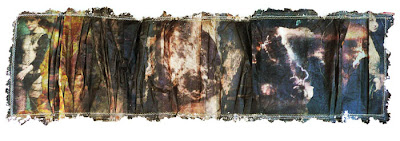
serie Inmolación, III- Fashion/Immolation series, III, Fashion-detalle-detail
Not long ago I came across the fact that in an almost extinct Australian aboriginal language, one of its various genders consists of women, fire, and dangerous objects. This interested me because the elements of this gender coincide with themes that I’ve explored in my own work. Women are a constant in my images, and although usually they are depicted in a vulnerable state, in a few instances they have appeared brandishing dangerous objects, notably a half-naked girl with a whip and boots that I drew when I was five, and a woman in a fifties bathing suit shooting at Guernica -to the consternation of certain lovers of Picasso- made when I was thirty. And for many years I have been collecting images of volcanoes and immolations (these either self inflicted or the product of lynching), as well as scenes involving people and fire (young Palestinians throwing Molotov cocktails, for instance). About the time I became aware of the language in question I had just started to make artists’ books from some of this fiery material.

serie Inmolación, III- Fashion/Immolation series, III, Fashion-detalle-detail

Entonces se me ocurrió que sería pertinente trabajar con las implicaciones de agrupar estas tres palabras potentes y hacer una investigación más sistemática de mujeres, fuego y objetos peligrosos. Siempre trabajo con imágenes de archivo, generalmente con archivos de mi propia invención, pero esta vez decidí utilizar ese gran archivo que es la red y empecé a meter en google search: images las palabras women fire o dangerous objects. Emergió un material muyinteresante e inesperado.

serie Inmolación, II/Immolation series, II-detalle-detail

So it occurred to me that it could be pertinent to work with the implications of grouping these three potent words: women, fire and dangerous objects, and to investigate them in a more systematic way. I almost always work with images from archives, usually archives of my own invention, but this time I decided to utilize that great archive, the World Wide Web, and started to put into -Google search: images- the words women fire or dangerous objects. A very interesting and somewhat unexpected material emerged.

serie Inmolación, II- Fashion/Immolation series, II

Bajo dangerous objects encontré referencias a meteoritos, por ejemplo, y una serie de imágenes en rayos equis documentando los objetos peligrosos e insólitos hallados tanto en cuerpos humanos como animales. Entre los casos de mujeres, destaca el de una joven china que padecía de dolor crónico, en cuyo cuerpo se encontraron más de 20 agujas que al parecer sus abuelos le clavaron en su infancia, deseosos de su muerte para abrir el paso al futuro nacimiento de un nieto varón. También empecé a pedir a amigos y parientes sugerencias sobre posibles objetos peligrosos y buscar imágenes de lo sugerido en internet.

serie Inmolación, II/Immolation series, II-detalle-detail

Under dangerous objects I encountered many references to meteorites, for instance, and a series of X-ray images documenting the dangerous and unusual objects found in bodies, both of humans and animals. Among the cases involving women, that of a young Chinese suffering from chronic pain stands out. In her body over 20 needles were found, apparently inserted into her as an infant by her grandparents, in an attempt to provoke her death and clear the path for the birth of a future male grandson. I also started to ask friends and relations for suggestions of possible dangerous objects and to follow up their suggestions with more internet image searches.

No intentes esto en casa/Don't try this at home

En cuanto a mujeres y fuego, encontré evidencia tras evidencia de una práctica en la India de aprovechar las fogatas abiertas de las cocinas tradicionales para quemar a las nueras o esposas indeseables (para luego buscar una dote mejor). Entre los que se inmolan, de los cuales tengo en mi colección tanto hombres como mujeres, había casos sonados de monjes que se quemaban por razones políticas, pero lo que más me sorprendió fueron aquellos que recurrieron a esta drástica medida después de que les fuese negado el permiso para abrir un negocio o por enfrentar un desalojo. En las pláticas resultantes a la pregunta “¿y qué estás preparando?” y mi subsecuente respuesta, salieron otras posibilidades, como la auto combustión, de la cual por coincidencia acabo de encontrar un caso en el libro Bleak House de Charles Dickens, que estoy escuchando (sí, audio) como parte de mis estrategias para no aburrirme mientras trabajo.

Centinela/Sentinel

As for women and fire, I found one story after another of a practice in India in which the traditional open kitchen fires are employed to burn unwanted daughter-in-laws or wives (with a replacement and her dowry in mind). Among those who burn themselves up, of whom I find both men and women in my collection, there are famous cases of monks who ignite themselves for political reasons, but what I find most surprising, in terms of motives, are those who recur to this drastic measure after being denied a permit to open a shop, or when faced with eviction. In the talks that regularly take place after being asked, “So what are you working on right now?” and my subsequent reply, other possibilities have emerged, such as auto combustion, of which I just happened find a case, by coincidence, in Bleak House by Charles Dickens, a novel I have been listening to (yes, free audio books!) as I work as one of my strategies to avoid boredom.

Centinela/Sentinel-detalle-detail

Hasta ahora iba trabajando con información muy limitada en cuanto a la fuente del concepto de mujeres, fuego y objetos peligrosos. Pero luego recibí en mi blog, donde había platicado algo de mi proyecto, un comentario sobre el lingüista George Lakoff , que publicó en los años ochenta un libro titulado Women, Fire and Dangerous Things, al parecer relacionado con ese idioma aborigen. Busqué el libro (en la red por supuesto) y encontré en su prefacio (cortesía de Amazon) que efectivamente se trataba del mismo idioma, que se llama el Dyirbal. Según otro sitio, al hablar en este idioma, cada nombre se precede con uno de cuatro clasificadores: Bayi, Balan, Balam, o Bala. Balan incluye mujeres y fuego y además, cierto tipo de armas como lanzas, el sol y las estrellas, animales insólitos como el platypus, ciertos insectos como los alacranes y las luciérnagas, algunas serpientes, perros, casi todas las aves y el agua. Analizado por R.M.W. Dixon, las categorías se pueden simplificar así: Bayi se aplica a hombres y a la mayor parte de los animales, Balan a mujeres, agua, fuego y pelea, Balam a la comida que no sea carne y Bala, a todo lo no incluido en otras clases.

Centinela/Sentinel-detalle-detail

Up to this point I had been working with limited information about the source of the concept women, fire, and dangerous objects. Then I received a commentary in my blog, where I had commented something about my project, to the effect that in the eighties, the linguist George Lakoff had published a book called Women, Fire and Dangerous Things which was probably related to the same aboriginal language. I looked for the book (in the web of course) and discovered from its preface (courtesy of Amazon) that it indeed had to do with that language, called Dyirbal. According to another site, when one speaks in Dyirbal, all nouns are preceded by one of four classifiers: Bayi, Balan, Balam, and Bala. Balan includes women and fire, and also some kinds of weapons such as spears, the sun and the stars, unusual animals like the platypus, some insects including scorpions and fireflies, certain snakes, dogs, most birds, and water. As analizado by R.M.W. Dixon, the categories can be simplified as follows: Bayi applies to men and most animals, Balan to women, water, fire and fighting, Balam to food which is not flesh, and Bala to everything not included in the other categories.

No intentes esto en casa/Don't try this at home

e

Los lingüistas se han fijado en el Dyirbal para el estudio de categorías, especialmente categorías culturales. A mí me interesan sus categorías por lo que puedan sugerir y las imágenes que pueda inventar a partir de ellas. Pretendo hacer con las imágenes y conceptos encontrados lo que suelo hacer con el material que trabajo: alterar, combinar y re contextualizar, en el intento de crear imágenes que ofrezcan algo que las palabras no abarcan.

Linguists have found Dyirbal very useful for the study of categories specifically related to culture. As for me, I find the language’s categories interesting for all they may suggest and for the images I can invent building on what I find in such suggestion. I intend to do with the resulting images and concepts what I always do with the material I work with: alter, combine, recontextualize, in an attempt to create images that offer something that words cannot convey.

obra en proceso/work in progess

miércoles, 4 de noviembre de 2009

Women, Fire, and Dangerous Objects/Mujeres, fuego y objetos peligrosos


I recently read that in the languaje of a certain Aboriginal group in Australia there are about 22 genders (as opposed to English which has none and Spanish which just distinguishes between male and female). One of these gender groups is comprised of women, fire and dangerous objects. Of course I immediately decided this would be a great title for a body of work, and now I've started on it.

Recientemente leí que en el lenguaje de cierto grupo aboriginal de Australia, hay como 22 géneros distintos (comparados con el inglés que no tiene géneros yel español que no más maneja masculino y feminino). Uno de estos géneros está compuesto por mujeres, fuego y objetos peligrosos. Por supuesto decidí de inmediato que esto sería un título fantástico para un conjunto de trabajos, y ya estoy en eso.

Esto y los que siguen, vistas del libro de artista "Inmolación", 2009- This and those that follow, views of the artist's book "Immolation"
Around the same time I was asked to contribute a few artists' books to an congress on graphics and the printed word in Oaxaca, Mexico, called Libre Tiraje. So my first incursions in the gender of women, fire and dangerous objects will see the light of day in Oaxaca.

Al mismo tiempo me habían pedido libros de artista para exponer en un primer encuentro de gráfica y escritura en Oaxaca, llamada Libre Tiraje. Entonces las primeras incursiones en esta vena se verán la luz de día en Oaxaca.

I have a small collection of newspaper clippings of volcanoes and people set on fire, either by themselves (in a couple of cases because they couldn't get permits to operate their businesses, curiously enough) or by lynch mobs. There are as well as few Palestine youths trying to set other things on fire. Actually these clippings have spent a long time lost in my papers but recently came to light once again, and I complemented them with a few images from the web. After a little photoshopping I made up a sequence in transfer on Japanese paper which is my first foray into the fire subject matter (though I worked a lot with volcanoes about 20 years ago, when I was travelling often through the Mexican landscape).

Tengo una pequeña colección de recortes de periódicos de volcanos y de gente en llamas, o auto inmolada (en un par de los casos representados porque no conseguiron permisos para operar sus negocios, curiosamente) o linchada. También hay varios chavos palestinos tratando de encendiar otras cosas. La verdad es que estos recortes estuvieron perdidos entre mis papeles durante mucho tiempo pero reciéntemente salieron a la luz otra vez, y los he complementado con unas imágenes de la red. Después de una sesíon en Photoshop pude hacer una secuencia en transferencia sobre papel japonés que es la primera salida de obra con lo relacionado con fuego (aunque hace 20 años trabajé mucho con imágenes de volcanos, en una época en que viajaba mucho en el campo mexicano.)

I had a hard time working on this piece because the images ended up affecting me, people in flames are disturbing subject matter (which is of course why they interested me in the first place).

Me costó trabajo hacer esta pieza porque las imágenes me llegaron demasiado. Gente en llamas termina por ser una temática perturbante (y por supuesto por eso me interesó en primer lugar).
The piece is called Immolation. -- La pieza se llama Inmolación.


I did another volcano piece at the same time, with an image based on a daguerrotype that the critic Olivier Debroise gave to me long ago -because the face was scratched in a way that made him think of my interventions in drawings.

Hice otra obra relacionada con volcanos al mismo tiempo, con una imagen basada en una daguerrotipia que me regaló el crítico OLiver Debroise hace mucho tiempo -poque la cara estaba rayada en una forma que lo hizo pensar en mis intervenciones en dibujo.

Fumarola/cerrado/closed/2009

Quise establecer una continuidad entre la sustancia negra saliendo de su boca (aparentemente) y la que salía del volcán en otra antigua foto mexicana.

What I wanted to do was to create a continuity between the black substance (apparently) coming out of the girl's mouth and that emerging from the mouth of the volcano in another old Mexican photograph.

Fumarola/abierto/open

El libro se llama Fumarola.

The name of the book in Spanish comes from the plumes of steam that the volcano throws off. This doesn't seem to work as a title in English, maybe something like Vapor would...or perhaps something a little more sinister. Black Words?

Meanwhile I keep digging up old copies of old prints and making collages of them with the new (manga) prints.

lotos y mujer reclinándose/lotus and woman reclining 2009

serie-flores-del-mal--velo-roto/series Fleur du mal-the torn veil 2010

Mientras tanto sigo sacando copias de viejos grabados para hacer collage con los nuevos (manga) grabados.

Sometimes I try to make a collage similiar to a previous one, but somehow they always turn out differently...

A veces quisiera hacer una versión parecida a otra previa, pero siempre me salen distintas...

Susana and the elders, second version/Susana y los viejos, segunda versión

miércoles, 16 de septiembre de 2009

unas observaciones/a few observations


My idea with this entry is to complete the gallery of images included in the exposition Elsewhere.
Above is a more complete (or more legible) version of the series Culture Shock.
This series (each one 80 x 80 cm) can go on infinitely as each one connects to the next.
Here a sequence of twelve (from the Arróniz show) can be seen.

Mi idea con esta entrada al blog es de completar la galería de imágenes de la exposición Elsewhere. Arriba encuentran a la serie Culture Shock, más completa (o más legible). Esta serie puede seguirse infinitamente como cada cuadro se conecta con el que sigue. Aquí ven una serie de doce cuadros de la exposición en la galería Arróniz.

Using these prints (which are cut from a material used for the soles of shoes, similiar to linoleum), I began to invent variations, intervening the printed plate with collage of smaller prints, or transfers, sewing, and/or the application of gold or silver leaf or metallic pigments. Below you see one of these works, which I called Susana and the Elders.

De estos grabados (en suela para zapatos, que es como linóleo) empecé a inventar variaciones, interviniendo el grabado impreso con collage de grabados más chicos o de transferencia, costura, y/o la aplicación de hoja de oro o plata o pigmentos en polvo metálico. Abajo ven una de estas obras, a la cual puse Susana y los viejos.


plus a couple of details....


y unos detalles.....


Below is another such work; this one is made up of two impressions on almost transparent Nepalese paper, with one sheet turned over on top of the other and sewn into place.
Two transfer prints (the same geisha, reversed) also sewn on, complete the image.

Abajo está otro ejemplo, hecho de dos impresiones en papel nepalés casi transparente, una hoja volteada y cosida sobre la otra. Se completa con dos imágenes de geishas (la misma volteada realmente).
It's called Parallel Planets.
Se llama Planetas paralelas.


The image below, printed from a smaller (50 x 50 cm) woodcut, has a drypoint print incorporated into it and is sprinkled with silver pigment. The girl is Xie Kitchin, one of Charles Dodgeson (Lewis Carroll)'s models, dressed up as a Chinese.

La imagen abajo, impresa de una xilografía más chica (50 x 50 cm) tiene incorporada un grabado en punta seca y está rociada con pigmento plateado. La niña es Xie Kitchin, una de las modelos de Charles Dodgeson (Lewis Carroll), vestida de chinita.

Below you see a ceramic plate printed with one of the plates from Culture Shock. The damp clay is printed using the plate, then rolled up and later covered with pigment which is eventually sandpapered off, leaving the pigment only in the lower parts of the relief.

Abajo ven un platón en cerámica, impreso de una de las placas de Culture Shock. El barro húmedo se imprime con la placa y se moldea, para luego ser cubierto con pigmento que eventualmente se rebaja con lija, dejando el pigmento en la parte más baja del relieve.


Above are two details of the composition below, which is assembled from the same woodcut print in different positions, with four small drypoint prints incorporated. It's called, Four ways of confronting the void.
Arriba se encuentran dos detalles de la composición abajo, compuesta de un grabado en madera en cuaro posiciones distintas, con cuatro grabados en punta seca incorporados. Se llama: Cuatro forms de enfrentar el vacío.

Another linoleum print (60 x 55 cm) was used together with three small drypoint prints (actually two prints, with one right-side-up and also up-side-down) on Japanese paper to make the version below, Children among Lotus.

Other grabado en linoleo, (60 x 55 cm), se ocupó junto con tres pequeños grabados en punta seca (bueno, dos, con uno impreso dos veces y puesto derecho y al revés) en papel japonés para hacer la versión abajo, Niños entre lotos.


And with the same plate, now upright instead of sideways, the following version was made, with three drypoint prints printed on pages from a Japanese stenography book. It's called, Gaki, a Warrior, and Carnivorous plants. The gaki are hungry ghosts, the medieval Japanese' explanation for the disappearance of organic waste.

Y con la misma placa, ahora derecho en vez de de lado, la versión siguiente se hizo, con tres grabados en punta seca impresas en hojas de un libro japonés de estenografía. Se llama, Gaki, guerrero y plantas carnívoras. Los gaki, fantasmas hambrientos, son la explicación de los japoneses medievales de la desaparición de los restos orgánicos.

A detail/Un detalle:


The Golden Flower: the diptych below. / La flor dorada: el díptico abajo.


And finally, a detail from another version shown complete in the previous entry: Love among samurais.

Y para terminar, un detalle de otra version que se vio completa en la previa entrada: Amor entre samurai.